Legal blog
What Happens If You Bounce a Cheque in the UAE in 2026?


Introduction
Many people mistakenly believe that bounced cheques are no longer punishable under UAE law. While recent legal reforms have changed how certain cheque-related offences are handled, bounced cheques can still lead to civil liability and, in specific circumstances, criminal prosecution.
This guide explains the legal position regarding bounced cheques in the UAE in 2026 and outlines the options available to both cheque issuers and beneficiaries.
What Is a Bounced Cheque?
A bounced cheque, also known as a dishonoured cheque, is a cheque that a bank refuses to honour. Common reasons include:
- Insufficient funds in the account.
- Closure of the bank account before the cheque is presented.
- A mismatch in the signature.
- Instructions issued to the bank to stop payment without lawful justification.
- Other legal or banking irregularities.
When a cheque is dishonoured, the bank typically issues a return memo stating the reason for non-payment.
Is Issuing a Bounced Cheque a Criminal Offence?
The answer depends on the reason the cheque was dishonoured.
Under current UAE legislation, issuing a cheque that is returned solely due to insufficient funds is generally no longer treated as a criminal offence in the same manner as it was in previous years. Instead, the law provides a faster civil enforcement mechanism to enable the beneficiary to recover the amount due.
However, criminal liability may still arise in circumstances involving fraudulent or unlawful conduct, including:
- Deliberately issuing a cheque after closing the bank account.
- Intentionally withdrawing funds to prevent payment of the cheque.
- Instructing the bank to stop payment without a legally valid reason.
- Forging or falsifying a cheque.
- Misusing or fraudulently altering a cheque.
In such cases, criminal proceedings may still be initiated in accordance with applicable UAE laws.
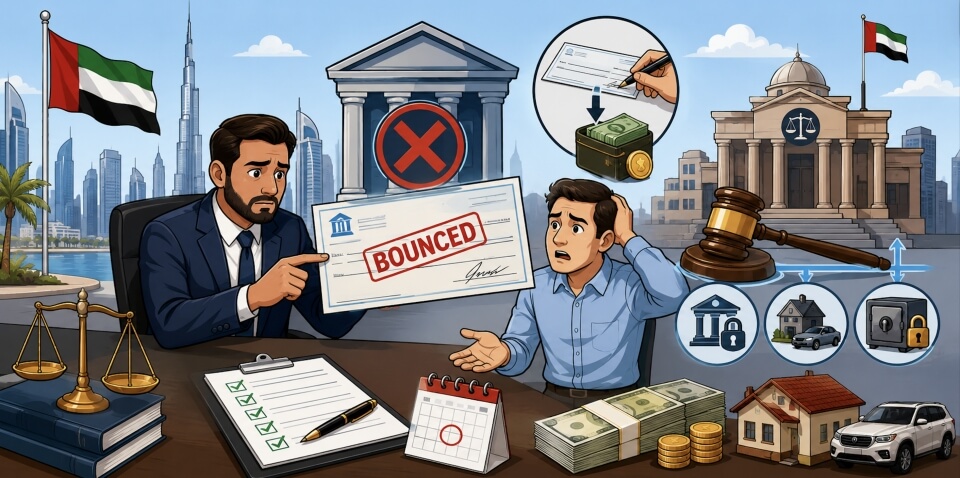
What Happens When a Cheque Bounces?
Once a cheque is dishonoured, several legal steps may follow.
1. The Bank Issues a Return Memo
The beneficiary receives official confirmation that the cheque has been dishonoured together with the stated reason.
2. The Beneficiary May Seek Payment
The beneficiary may contact the issuer to seek voluntary payment or settlement before initiating legal proceedings.
3. Civil Enforcement
Under UAE law, a dishonoured cheque may serve as an executive instrument in many circumstances, allowing the beneficiary to commence enforcement procedures without first obtaining a separate court judgment.
Depending on the case, enforcement measures may include:
- Attachment of bank accounts.
- Attachment of movable or immovable assets.
- Salary attachment where legally permitted.
- Travel ban applications, where the legal requirements are satisfied.
- Other enforcement measures available under UAE law.
Can a Travel Ban Be Imposed?
A travel ban is not automatic.
In appropriate cases, the creditor may apply to the competent court for precautionary or enforcement measures, including a travel ban, subject to the legal requirements and judicial discretion. Whether such an application is granted depends on the facts of the case and the applicable law.
Can the Parties Settle the Matter?
Yes.
Many bounced cheque disputes are resolved through negotiation before or during legal proceedings.
Possible settlement options include:
- Full payment.
- Payment by instalments.
- Partial settlement.
- Written settlement agreement.
- Withdrawal of legal proceedings where appropriate.
Early legal advice often helps both parties avoid unnecessary litigation and additional costs.
What Should You Do If Your Cheque Has Bounced?
If you issued a cheque that has been dishonoured:
- Contact the beneficiary immediately.
- Attempt to negotiate a practical settlement.
- Avoid ignoring legal notices or court communications.
- Obtain legal advice as early as possible.
- Preserve all payment records and correspondence.
Prompt action may significantly reduce legal costs and prevent enforcement measures.
What Should You Do If You Receive a Bounced Cheque?
If you are the beneficiary:
- Obtain the bank's cheque return memo.
- Keep copies of all supporting documents.
- Seek legal advice regarding the appropriate enforcement procedure.
- Consider whether negotiation or legal action is the most effective course.
- Act without unnecessary delay to protect your legal rights.
Frequently Asked Questions
- Can someone go to jail because of a bounced cheque?
- A cheque returned solely for insufficient funds does not automatically result in imprisonment. However, criminal liability may still arise where the cheque involves fraud, account closure, unlawful stop-payment instructions, forgery, or other criminal conduct.
- Can a bounced cheque be enforced without filing a full civil lawsuit?
- In many cases, yes. UAE law allows certain dishonoured cheques to be enforced directly through the execution courts, subject to the applicable legal requirements.
- Can a bounced cheque affect my business?
- Yes. It may damage commercial relationships, affect business reputation, and result in enforcement proceedings that impact business operations.
Conclusion
The legal treatment of bounced cheques in the UAE has evolved significantly. Although a cheque returned for insufficient funds is no longer automatically treated as a criminal offence, it remains a serious legal matter that can lead to enforcement proceedings, financial liability, and, in certain circumstances, criminal prosecution.
Whether you are a creditor seeking to recover unpaid funds or an individual or business facing a bounced cheque claim, obtaining timely legal advice is essential to protect your rights and achieve the most effective resolution.
Written by:
Saeed Suhail Alrashdi | Saeed Alrashdi Advocates & Legal Consultants










This publication is for general information purposes only. It does not purport to provide comprehensive full legal or other advice.
Legal Advice Middle East and the contributors accept no responsibility for losses that may arise from reliance upon information contained in this publication. This publication is intended to give an indication of legal issues upon which you may need advice.
Full legal advice should be taken in due course from a qualified professional when dealing with specific situations.